
Q2 2026 Recap
Progress towards grad school & finally writing more
I previously wrote my recaps on Medium, but I’m going to shift them to my personal site, starting with this post. In many ways, most of Q2 was a continuation of the work from Q1: Working at Metabolic Collective part-time while completing my prerequisite art studio courses for my MFT program. I traveled a bit, too, but what really shifted in Q2 was picking up the cadence on my Substack writing.
Above: The 1second of the day compilation from Q2. I haven't been as devoted to the 1SE practice, so it's not as comprehensive as past videos. A lot of family time with living in Calabasas again and art studio time with courses.
Writings*
I averaged 2 articles/mo on Substack.
On my science blog, The Patient Scientist, I wrote:
And on my art blog, Harari Art, I wrote:
Interestingly, the personal story about my metabolic health performed the best. And by “the best”, I mean a couple virtual reactions. Comments, restacks, and the sorts.
More notably, a couple friends and family pledged to sponsor my science Substack. I hadn’t even realized that feature was enabled. It got me wondering about the value I could return to readers and whether Substack has “side hustle” potential. Going into Q3, in my articles I’ve suggested to my readers that they can “pledge” some subscription amount if they want me to review more products. I don’t have much of a following at the moment (just 27 subscribers as of writing this recap on August 9th, 2026). It’s not yet clear what would prompt a reader to pledge. I’m hoping to return value in multiple ways… Empowering the general public to join research studies and assess test kits they may want to purchase. Synthesizing D2C info and sharing creative ideas with scientists designing those test kits… What is clear to me is what I’ve known since undergrad… I love science writing. For now, my science Substack will continue to be a passion project. If anyone has ideas on how to more effectively monetize it, though, do let me know!
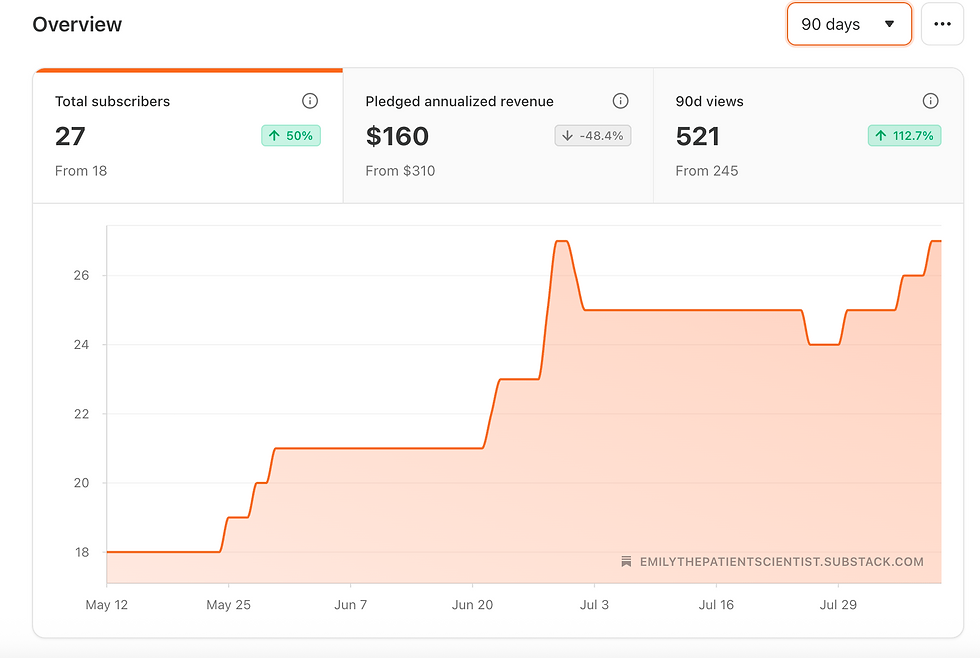
Above: A recent snapshot of my Substack dashboard for The Patient Scientist. Humble beginnings. Documenting the journey.
Travel
I joined Rebecca and Jordan on their Mexico City trip. I feel very lucky to have found such good new friends in LA. Mexico City was alive with colorful murals and tantalizing street tacos. The city beautifully addresses its indigenous and colonial histories, with so many free museums. It’s a great city to wander through and everyone is so friendly.
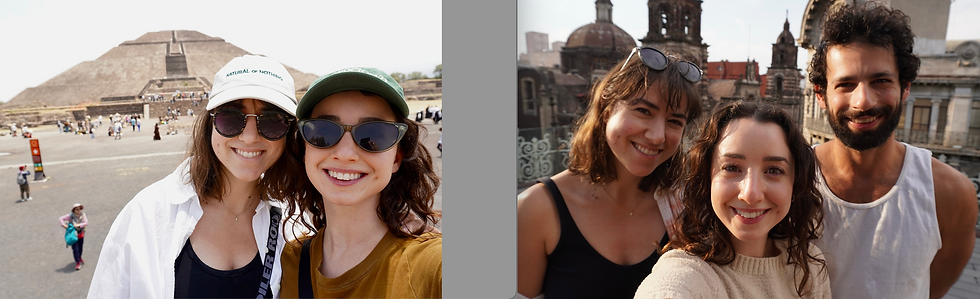
Above: Pictures from Mexico City trip with Rebecca and Jordan.
Biotech
While in Mexico, I presented a virtual webinar to the Association of Diagnostics and Lab Medicine (ADLM) alongside Dina Greene and Brad Collier. Brad is an R&D director at Labcorp and Dina is a multi-faceted clinical chemist– a clinical professor at University of Washington and the founder of her very own Evergreen Labs, where she balances multiple research projects with big pharma. Dina initially connected with me on LinkedIn after reading some of my forecasting posts. I gave her some practical tips on implementing decentralized research the “scrappy” way I learned at ImYoo. I’m grateful she invited me to present alongside Brad and herself at ADLM to an audience of chemists interested in decentralizing their workflows. It’s easy to experience imposter syndrome amidst this community of PhDs, but I see a lot of value my perspective can bring as someone who can translate the theory of patient centric sampling into something more accessible for real-world adoption. The perspective I gained from ImYoo and the PCSIG, my creative ideas, and my scicomm skills in communicating those ideas have captured peoples’ attention. I’m lucky to have these opportunities to share it.
I wish I could share the recorded presentation, but it is behind the ADLM paywall:/ I also haven’t heard back from the CoSci team about my presentation recording there, either. Perhaps, I’ll re-record with my slides for a future Substack post.
*Writings Side-Note
Dina, Brad, and connections from ImYoo also gave me some input on my Mitome research. I didn’t link that article here, because it technically came out in Q3. However, most of Q2 was spent following up every couple of weeks with potential leads to establish contact with Chris Masterjohn, the company’s founder, and ask him my technical questions.
I spent a while on the Mitome article. I used to watch non-fiction films based on investigative journalists and imagined myself doing that work somewhere like the Wall Street Journal or the New York Times. Those movies paint such simplistic pictures of wrongdoers and right-doers. I generally give the benefit of the doubt, so perhaps I don’t have the right disposition for that work. Moreover, in this direct-to-consumer testing world that I’m covering, things are rarely so black and white. I was just happy to establish contact with Chris and pitch him on my research ideas. I hope to work with him someday. In the meantime, I learned a lot about how to fairly scrutinize a product without alienating the founder.
MFT
I wrapped up my art studio pre-requisites for LMU. In the process of getting my last credits, I discovered a hidden gem… Figure drawing at Miles Lewis’ art studio in Woodland Hills. It was meditative. The property, a peaceful sanctuary. With my credits wrapped up, I’m scheduled to start my masters in Art Therapy at the end of this month (Aug 31st). Everyone keeps asking me if I’m excited to be a student again.
I’ve always felt like a student, even after undergrad finished. I’m constantly listening to podcasts and jotting down new ideas in my notes app. Finding a new sense of community on my college campus is exciting, but I have to admit that those feelings are often overshadowed by anxiousness. I’m entering the mental health field as someone wanting to reform it. Like the Mitome article, I’m critical because I care, but– as a result– I tend to have my guard up.
This program will really challenge me to sit with discomfort, be open to alternative perspectives, and– most of all- practice patience, with myself and with others. These are all qualities I set out to cultivate at the top of 2026 and continue to remind myself with the mantra, “Moth to Flame.” (You can find the vision board on my iPhone screensaver.)
Health
When I feel doubtful about the MFT path, I think back to Jordan Peterson’s prompt: “You see what you aim for.” In the wake of a challenging year and half in withdrawal, which was filled with emotional highs and lows, I entered 2026 with the intention to cultivate a more grounded sense of being. I’m “aiming for” my values of connection, service, and curiosity. As a natural next step, I thought I would translate those values into a career of helping others navigate antidepressant withdrawal and rediscover agency in their health journies. Indeed, it’s been affirming to see this issue taken more seriously, with the Overmedicalization of Mental Health Summit that took place in May.
In Q2, I got down to 0.16mL on my taper, which prompted my purchase of ever-smaller syringes. It’s somewhat comical, inching the meniscus on my tiny syringe by just one hundredth of a milliliter. One drop of this medication can have ripple effects on a dependent nervous system like mine. My physician at Outro is tapering, too, actually. There’s something special about us both navigating this together. It certainly is a unique situation. I asked my doctor if she'd ever want to write about her experience. I envisioned drafting a book that followed our parallel journeys of physician and patient navigating the same health experiences at the same time. For understandable reasons, she chooses to keep these details of her life private. I'm still not sure what compels me to be vocal about my experience. I think, in part, it's to rectify what feels wrong. More so, I think it's to make sense of the medical and the existential.
*Side note: I enjoyed weekly kundalini sessions with my instructors, Greg and Dawn, at their Topanga Canyone estate. I loved emerging from the yoga dome to the sound of the nearby peacocks "coo-ing" and "caw-ing" their lullabies in the every-longer golden hours. I noticed overlap with what I learned from Dr. Kim in our qi gong lessons. For myself, I find there are definitely nervous system benefits to the kundalini breathwork. I also see molecular connections with Chris Masterjohn's theories on SSRI-associated hypoxia signaling.
Looking toward Q3
In Q3, I’m exploring video content and testing out posting strategies for The Patient Scientist. I’ll also be starting my MFT program. As of writing this, I’ve already got the ball rolling on the blog side and I’m getting involved virtually in various social prescribing groups, which strongly steered me toward art therapy, specifically. Looking forward to sharing those updates in the next recap. See you when September ends.
Comments